
Do You Matter? How Great Design Will Make People Love Your Company
by Robert Brunner and Stewart Emery with Russ Hall

In September of last year, we had Adam Nielsen on the show for a recommended book list, where we talked about books we liked and were looking forward to. After the recording was done, I checked my email and saw Robert Brunner had just released his first book. Great, a guy we had on our previous podcast, that changed my way of thinking, was once again telling me I was wrong and should try harder. I should have picked his book. I ordered it just minutes later, and when it arrived, it sat on the shelf with the others waiting to be read. It sat there for two months at least. Then, I started reading it. Just a few pages, maybe a chapter at most – a week or more between readings. Three chapters in and I started to think this book wasn’t written for me, but for some big CEO to tell them how design can change their business. Not for how I should be changing my business. Not for how I should be thinking about design.
He talks about designing a new grill. Not to just design a better grill, but to design the grilling experience. Take a step back – you realize the issue isn’t with how the grill works, it’s that the person running it has his back to the other people. The grill isn’t the problem, the experience is. The cook is not engaged in the dialog. The problem is that the hood gets in the way of the experience.
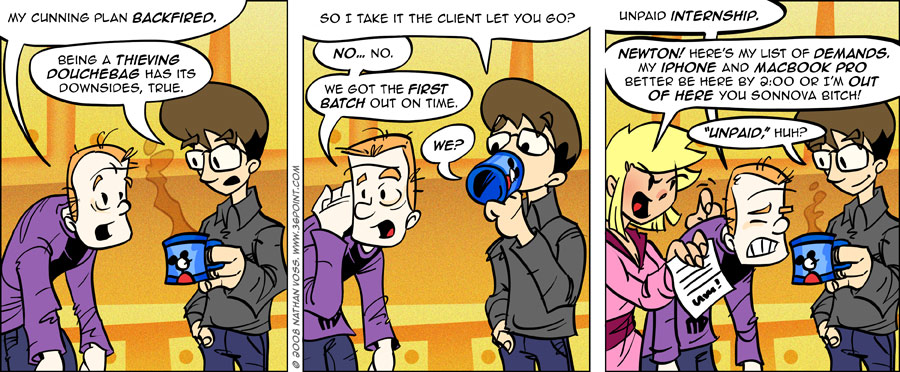
I would call today’s comic the stunning conclusion, if in fact I were perfectly aware that most readers knew I was telling a cohesive story this week (the titles of each were renamed and numbered ex-post-facto). In fact, now that it has been completed, I would wholeheartedly recommend that you experience the entire trilogy from the beginning.
I was going to start writing a bit more about a book I’ve been sent, and have been subsequently reading, titled Do You Matter? by man-god Robert Brunner and mortal Stewart Emery. I’m not far enough through it to give a wholehearted analysis yet, though. On the initial take, however, I’d describe it as a book more for CEOs than midwestern-based, sole-proprietor graphic designers, though there’s simply a ton a of great information in there that isn’t hurting me to have access to. In some ways it is like a larger version of the Brand Gap, taken from a much wider perspective and written with effect to punch you in the face. More on that next week.
Lastly, I have to say, last night’s The Office gave my wife and I designer-fits when the following conversation took place between Pam and Jim, regarding her “art school:”
Jim — “Failing? I thought you were good at Flash?”
Pam — “I was good at Flash, but then we switched to Acrobat just when I was learning Quark!”
How does that conversation make sense!? WTF NBC? Number one, I don’t think Acrobat means what you think it means. Number two, nobody uses Quark for anything anymore. Number three, your random listing of design software ruined the show last night. For me and like, probably 20 other people. But those 20 people are all sooooo maaaaaad.
–nv–


Nate Voss is a designer, illustrator, talkshow host and design journalist. Working in Omaha since 2001, Nate served four years on the Board of Directors for
Donovan oversees all creative development at